

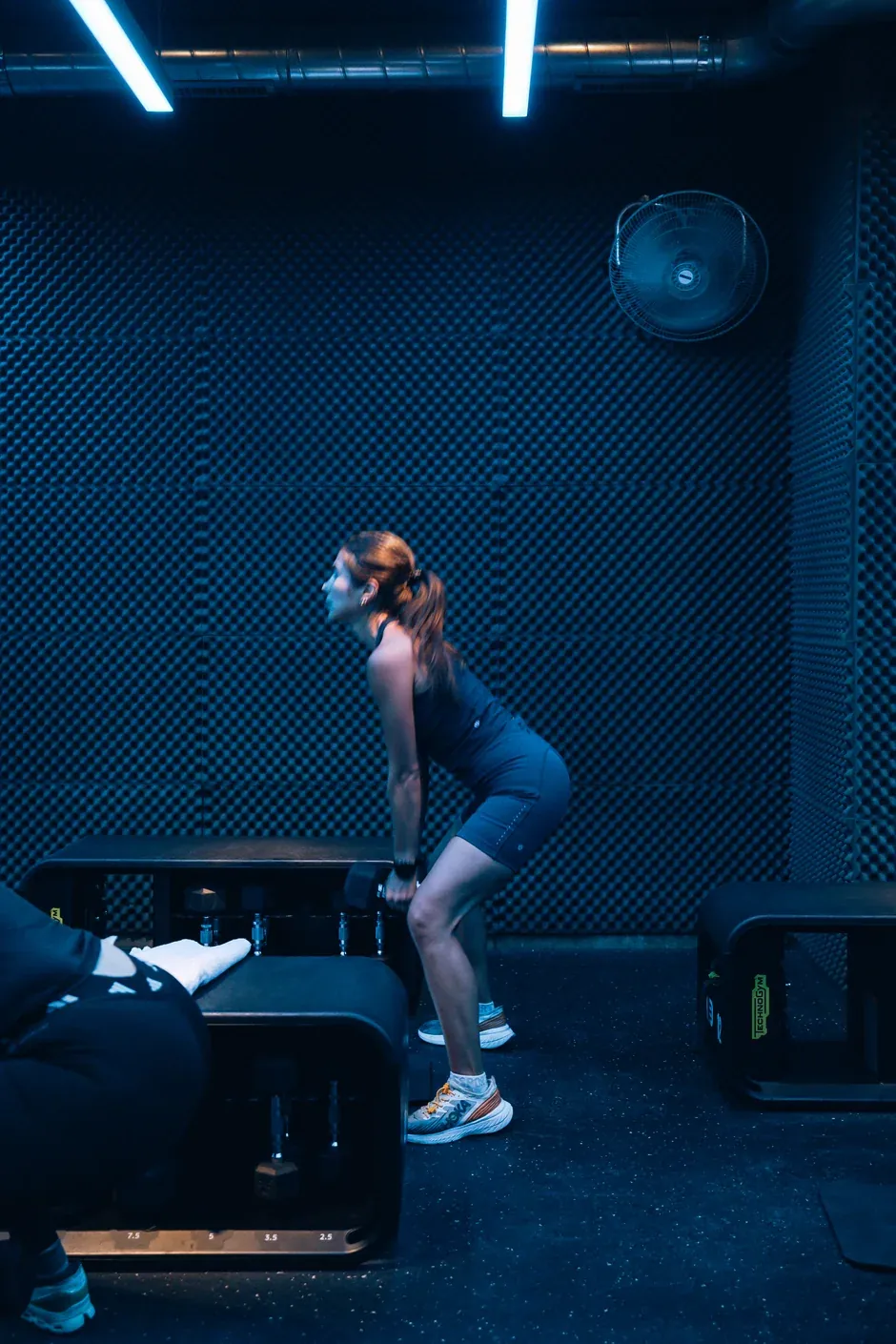
The first weeks are fine. Everything is new, you’re sore, and being sore feels like proof.
The difficult stretch comes later. You’ve been coming consistently, you’re still finishing sessions properly worked, and the movement still doesn’t feel like yours. Your body does something slightly different every time you try it, and nothing about it looks like progress.
That’s the stretch where people decide this isn’t for them. It’s also the stretch where the thing they came for is actually being built.
The short answer
Muscle memory in the sense that matters early on is motor learning: your nervous system laying down a movement pattern by repeating it. It’s the slowest and least visible part of training, it feels clumsy while it’s happening, and it has no finish line you can see. The awkward stretch isn’t a sign you’re bad at this. It’s the pattern being written.
What is muscle memory, actually?
Two different things go by that name, and only one of them is settled.
The first is motor learning, and it’s what you’re building in your first months. Your nervous system gets better at recruiting the right muscle fibres, in the right order, at the right moment.
A 2025 review in Frontiers in Physiology describes early-phase strength gains in novices as primarily driven by neural adaptations, with the nervous system becoming more efficient at recruiting motor units and coordinating muscle activation before significant growth occurs.1
That’s the version that explains why you feel clumsy. Your body is genuinely learning something it doesn’t know yet.
The second is the one you hear about at parties: that your muscle remembers its old size, so if you stop and come back it returns faster. That one is less settled than the internet suggests, and we get to it further down.
Why does it still feel clumsy after a month?
Because a movement pattern is a skill, and skills take longer to build than fitness does.
Think of anything else you’ve learned with your hands. Driving, an instrument, a sport as a kid. There’s a long stretch where you know what you’re supposed to do and your body does something else, and no amount of wanting it fixes that. Only repetition does.
Strength is the same, and it’s harder to see because there’s no obvious scoreboard. You can’t hear a wrong note. You just feel vaguely uncoordinated and assume you’re the problem.
The clumsy part is not the obstacle in front of the training. It is the training.
Soreness doesn’t help you read it either. It tells you that you did something unfamiliar, which is information about novelty rather than progress. Some of the most productive weeks feel unremarkable at the time.
The only line worth watching is this one: if you’re sore enough that the next session gets skipped or watered down, the first one cost more than it gave. That’s a programming problem, and it belongs to the coach, not to you.
Does it get easier?
No, and we’d rather say that plainly than sell you something else.
Our classes are hard. They’re hard for the person who walked in for the first time this morning and they’re hard for the person who has been coming for years. Both leave properly worked. Both can be sore the next day.
What changes isn’t the difficulty. It’s the fit. The class gets adapted to you, not softened for you. Same session, same structure, loads and progressions set for where you actually are, which is why one room can hold a complete beginner and someone with years behind them without either wasting the hour.
Boost Fitness has been open five years. The people who have been coming that long are not doing a gentler version of the class. They’re doing a heavier one, and they still walk out having worked.
So if you’re worried you won’t keep up, that’s the wrong worry. You’ll be given work you can do. It just won’t feel like a rest. And if you’re worried it’ll get boring once you know what you’re doing, that’s the wrong worry too.

Why this matters more in strength than anywhere else
Because in strength you load the pattern.
Run a slightly inefficient stride and you get a slightly slower kilometre. Hinge slightly wrong under a loaded bar and you’re repeating that shape with weight on it, week after week, writing it in deeper each time.
Twelve weeks of repeating a movement badly builds a pattern too. It’s just not the one you wanted.
This is the whole reason strength is the pillar people most often get wrong on their own, and the one where having somebody watching changes the outcome most. Not because you can’t be trusted. Because you can’t see your own back.
What about coming back after a break?
Here’s where we’ll be more careful than most people writing about this.
The popular claim is that muscle permanently retains extra cell nuclei from previous training, so a trained body regrows faster after time off. It’s a lovely idea and it may well be true in part.
A 2025 review in Frontiers in Nutrition is direct about the state of the evidence: findings in animals did not translate to an enhanced hypertrophic response during retraining in human studies, it remains unclear whether accrued nuclei persist indefinitely, and the topic remains uncertain.2
What we can say without stretching anything is the part you already know from experience. Coming back after a break is easier than starting from nothing, because the pattern you learned is still there. You’re not relearning the movement, you’re reloading it. That’s the motor side, and that one isn’t in dispute.
The stretch where people stop
Almost nobody stops in the first weeks.
They stop later, in the stretch where the novelty has gone and nothing visible has arrived yet.
That timing makes sense once you know what’s happening underneath. The neural work is real and it doesn’t photograph. The structural change hasn’t caught up. Everything feels like it should be clicking and it isn’t quite.
If you know that stretch is coming, it stops being evidence that you’re failing and becomes a stage with a name. That single reframe keeps more people training than any programme ever has.
And the marker that actually tells you it’s working isn’t the mirror or your level of tiredness. It’s this: can you do more good work this month than last month? More sets that hold their shape, a movement that needed three cues now needing one, a weight that felt precarious now feeling controlled. That moves long before anything else does, and it’s what your coach is watching.
One room, one job
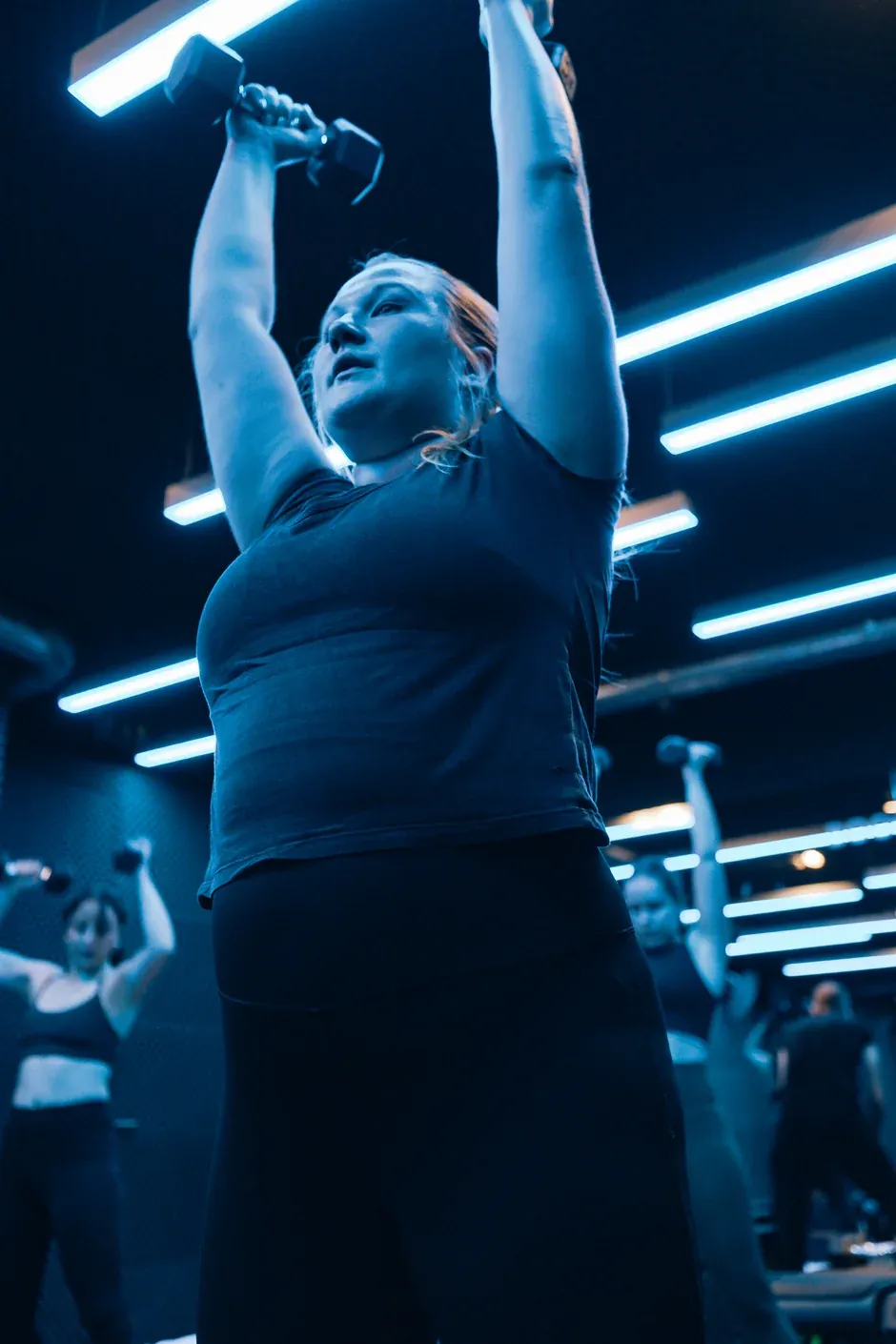
Boost Fitness has its own house at Plainpalais, and it does one thing.
That sounds like a limitation. It’s the reason the session works. Nothing to wait for, nobody circling your rack, no adapting the plan because what you need is occupied for twenty minutes. A strength session is a sequence, and an interrupted sequence stops being one.
Four formats rotate across the week, so nothing gets quietly neglected:
- 01Fullbody
- 02Lower Body
- 03Upper Body
- 04Abs & Core
The programming handles the rotation. The coach handles what each person in the room is actually doing with it, which is the part that decides whether the pattern gets written correctly.
Who it’s for
Everyone who wants to stay strong. That’s the actual answer, not a slogan.
- Never lifted
Someone who has never held a barbell and wants to be taught rather than left to copy the person next to them.
- Coming back
Someone returning after a year away who needs an on-ramp instead of their old numbers.
- Ten years in
Someone who has trained for a decade, knows exactly what they’re doing, and would rather not be their own coach any more. This group is bigger than people expect.
What none of them tells you on day one is the real reason they keep coming back, which is that the awkward stretch is far easier to sit through with company.
The person setting up next to you is somewhere in their own version of it. Someone in that room has been coming five years and still has a movement they’re annoyed about, and at some point you’ll hear them say so out loud. That will do more for you than any article, because the thing you were quietly carrying, that you’re the only one this isn’t clicking for, turns out not to be true and never was.
Then there’s a coach who remembers what you lifted last week. It sounds administrative. In practice it’s the whole difference between training and turning up, because somebody else is holding the thread of your progress on the weeks you can’t be bothered to hold it yourself.
One thing to do this week
Pick the movement that feels most awkward and give it eight more weeks before you judge it.
Write today’s date next to it. Not the weight. Just the date, and one line about what feels wrong.
Come back to that line later. What you’ll notice isn’t that it got easier. It’s that you stopped having to think about the part that used to need thinking about, which is what a pattern is.
STRENGTH is one of the five pillars, and it’s the one the other four draw on. How the cycle works →
Boost Fitness · Plainpalais · Qualitop certified
One honest note about starting.
Fourteen days won’t tell you whether you’re getting stronger, and anyone who says otherwise is selling something. What the Welcome Package does tell you is whether this fits your week: the room, the coaching, the schedule, the walk home. That’s the question worth answering first, and it’s the one you can answer quickly.
Plainpalais is about ten minutes from Eaux-Vives by bike, fifteen on public transport, and your package works at both houses on the same credits.
Discover the Welcome PackageSources
- Aslam S, Habyarimana JD, Bin SY. Neuromuscular adaptations to resistance training in elite versus recreational athletes. Frontiers in Physiology. 2025;16:1598149. doi:10.3389/fphys.2025.1598149. Review.
- Pérez-Castillo ÍM, Ruiz-Caride SR, Rueda R, López-Chicharro J, Segura-Ortiz F, Bouzamondo H. Skeletal muscle memory: implications for sports, aging and nutrition. Frontiers in Nutrition. 2025;12:1701520. doi:10.3389/fnut.2025.1701520. Review.