

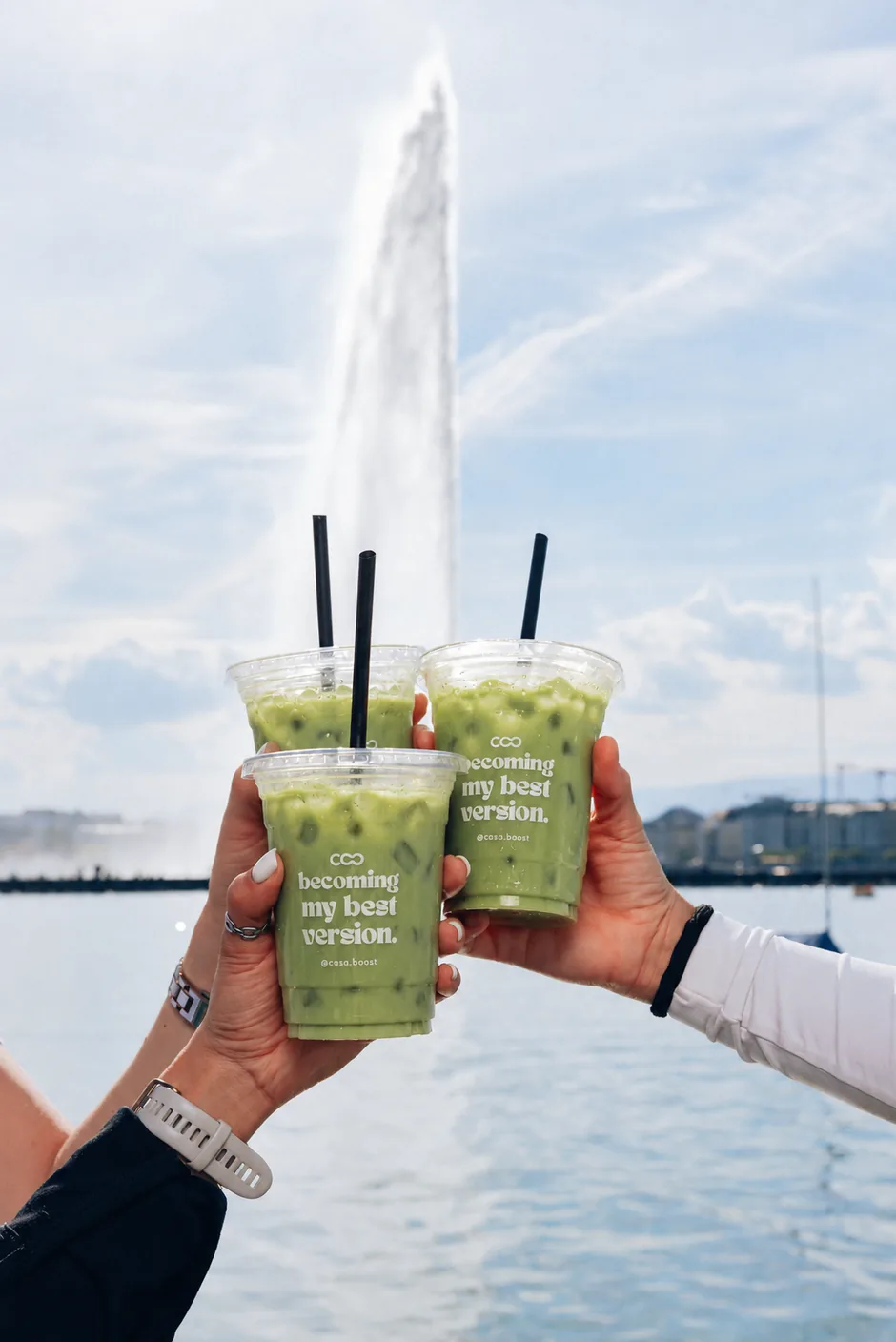
It’s ten past three. You’ve read the same paragraph twice. There is a specific flavour of tiredness that isn’t sleepiness exactly, more like your brain has quietly closed one of its tabs.
So you go and get another coffee, because that’s what you did yesterday, and it works for about forty minutes.
The honest version of what’s happening has almost nothing to do with the cup in front of you at three. It has to do with the one at nine.
The short version
Matcha carries caffeine and L-theanine together, and a 2025 meta-analysis found small improvements in attention a couple of hours after taking them, with the authors clear that the size of that effect is uncertain. Practically, it’s a drink you take slowly and almost never with sugar, which suits an afternoon better than a second espresso taken as a rescue. What it won’t do is cancel your three o’clock, because that’s mostly set by the shape of your caffeine earlier in the day and by how you slept. The lever is before lunch, not at three.
Does matcha stop the afternoon crash?
Not on its own, and what it does do is more interesting than the claim you’ll read elsewhere.
A 2025 systematic review in Nutrition Reviews pooled the randomised trials on caffeine and L-theanine together. Against placebo it found small-to-moderate improvements in attention accuracy at the two-hour mark, and a faster simple reaction time at two hours. The parts most articles leave out: mood wasn’t significantly affected, and the authors are explicit that the confidence intervals leave real uncertainty about how big the effect is. [1]
So it’s a modest, genuine finding about attention over a couple of hours. It isn’t a claim about your afternoon, and we looked for the trial that would be, comparing people’s afternoons on matcha against their afternoons on coffee. As far as we can tell nobody has run one.
Nothing you drink at three fixes an afternoon that was decided at nine.
Which is the useful news, because nine in the morning is something you control.
So what actually causes it?
Two things, and neither of them is what you drink at three.
The lift from the morning is wearing off. Caffeine doesn’t switch off, it drains. A 2022 study measured a median half-life of about four and a third hours in twenty healthy young men, so roughly half of what you drank at nine is still in you at half past one, and the rest leaves across the afternoon. [2] Which means the help fades. It doesn’t mean the caffeine caused a crash, and that distinction is the difference between understanding your afternoon and blaming the wrong thing for it.
And the time of day itself. This part is ours rather than a finding we can cite: the early afternoon is a low point for most people, with or without caffeine, and it tracks much more closely with how you slept than with what you drank. Anyone selling you a drink that cancels it is selling you something.
So the lever isn’t the three o’clock cup. It’s the shape of the whole day’s caffeine, and that’s decided before lunch.
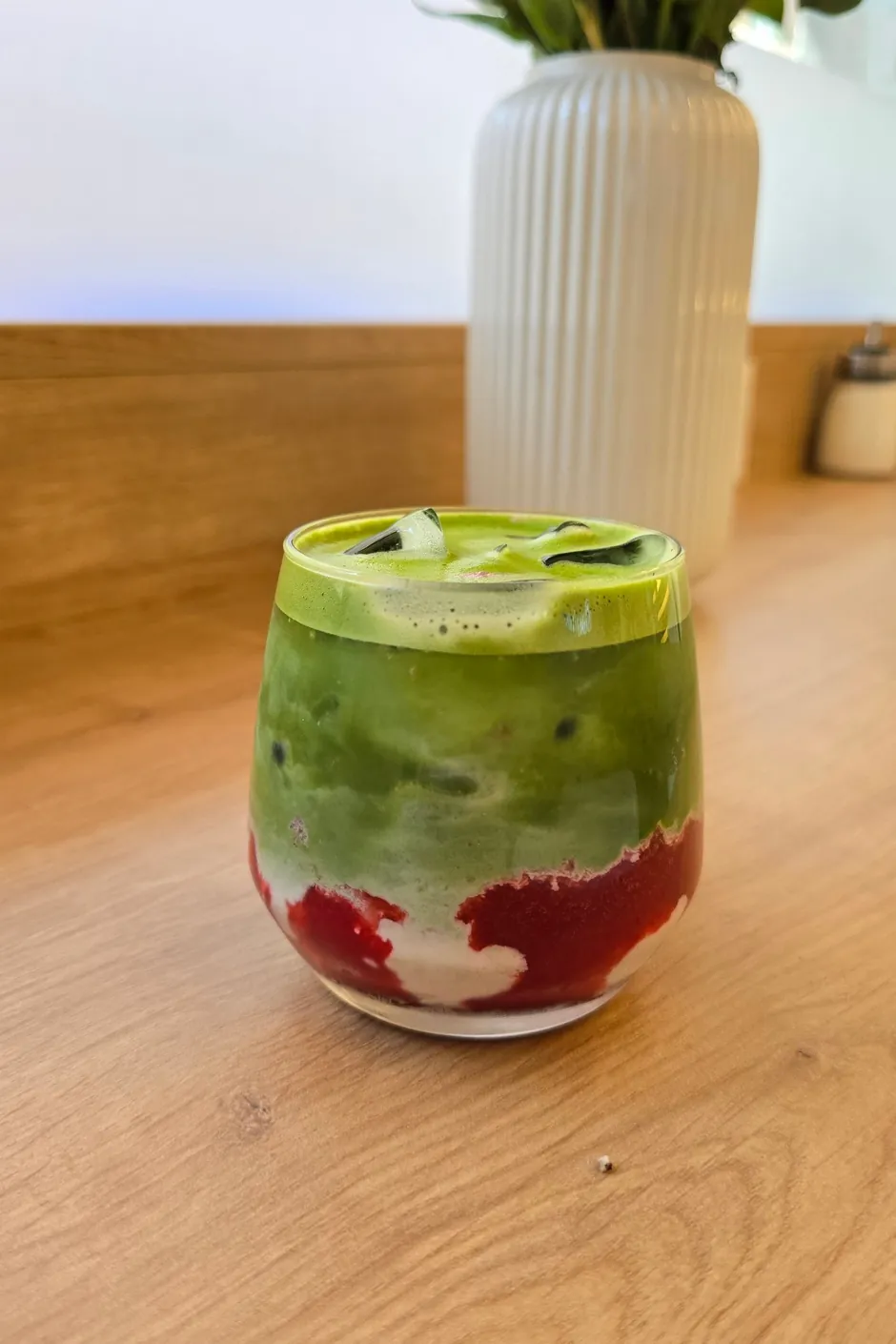
So why do we actually drink it here?
Because of its shape, not its magic.
You drink a matcha slowly, because it’s hot and it’s a bowl rather than a shot. It arrives without sugar unless you ask. And it comes with the L-theanine those trials were testing, which is the part a coffee doesn’t give you.
It also comes with ten minutes. Getting one means standing up, walking somewhere and stopping looking at a screen, and the drink is what gets you to do all three. Most people’s afternoons would improve from the pause alone, and almost nobody takes the pause without a reason to. The matcha is the reason.
The one we’d point you to first is on the Inspire side of the menu, mango and matcha, the shake named after the RESTORE pillar. The afternoon is when it makes most sense.
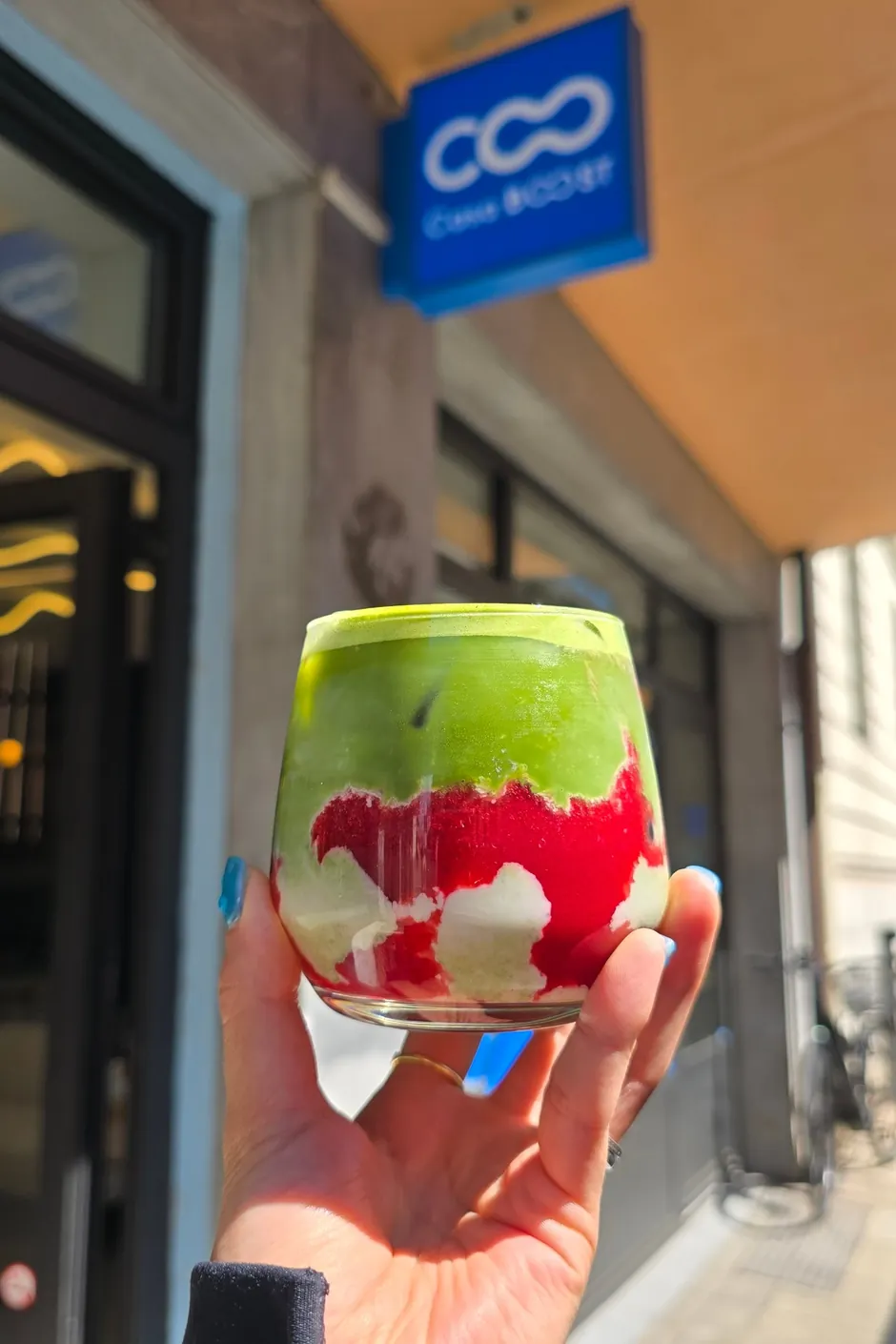
By mid-afternoon The Well Lab has slowed down and people stay longer than they meant to, usually with a laptop they stopped using twenty minutes ago. It’s also the kind of counter where you end up in a conversation with whoever is making your drink, which is not what you came for and is usually the better part of it.
None of that is incidental. A room you want to sit in is what makes a ten-minute pause last ten minutes instead of two.
And if you train here, the afternoon is the half of the day that decides whether the morning session lands.
What to do about your afternoon
Three things. The first two are about caffeine and cost nothing.
The third has more leverage than both put together and is a bigger project.
Move your biggest caffeine earlier, not later. The afternoon is mostly decided before eleven. If you’re drinking most of it at nine and again at one, the one o’clock is the one to look at first.
Put something in the three o’clock slot that isn’t a rescue. A slower drink taken as a pause works differently from a bigger one taken as an emergency, even at similar caffeine, because the pause is doing some of the work.
Then look at your sleep, because that’s the variable with more leverage than everything above combined, and no cup is going to argue with it.
Move the big dose earlier and three o’clock stops being a cliff and becomes a flat bit. Not energetic, just no longer a hole to climb out of. Then it stops being interesting, which is how you know it worked. Nobody notices a normal afternoon.
One thing to change this week
Write down what time you drink caffeine for three days. Just the times, not the amounts.
Most people have never actually looked, and the pattern is usually obvious: a large dose first thing, a second around lunch, and a flat spot at three that was built in the morning.
You can fix a pattern. You can’t fix a three o’clock.
REFUEL is one of the five pillars, and it’s the one that decides whether the other four hold up across a week rather than a session.
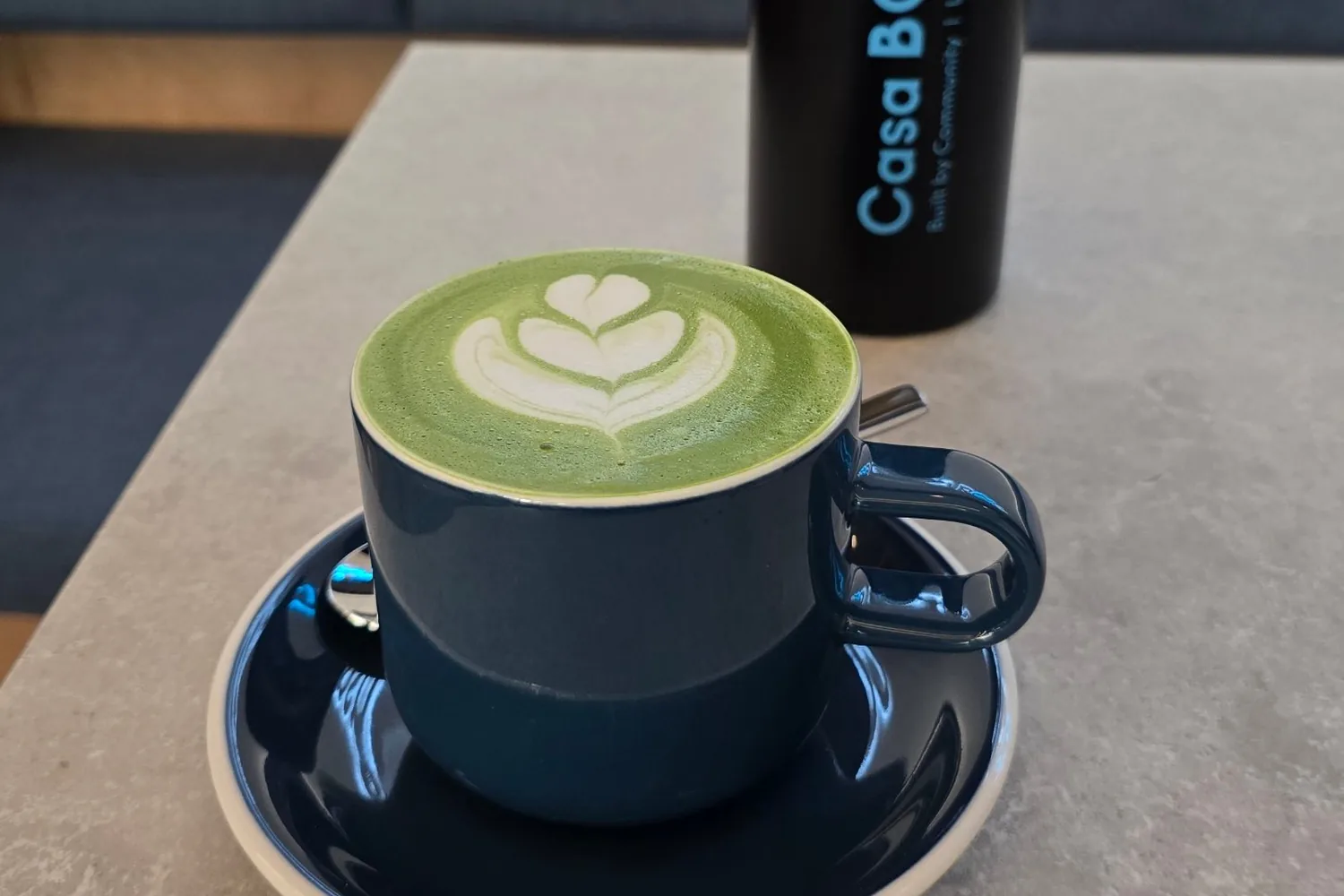
The Well Lab is open to everyone, whether you trained that morning or have never trained here at all. The menu is organised by what the day is asking of you rather than by what it tastes like, which is the same logic as everything above. You can order ahead from the app, on iPhone or Android, so it’s waiting when you get there.
REFUEL · one of the five pillars of the CASA BOOST Method™
The Well Lab
Eaux-Vives, open to everyone. Shakes, coffee and matcha organised by what the day is asking of you, and a room that makes a ten-minute pause last ten minutes.
See The Well LabSources
- Payne ER, Aceves-Martins M, Dubost J, Greyling A, de Roos B. Effects of tea or its bioactive compounds l-theanine or l-theanine plus caffeine on cognition, sleep, and mood in healthy participants: a systematic review and meta-analysis of randomized controlled trials. Nutrition Reviews. 2025;83(10):1873-1891. doi:10.1093/nutrit/nuaf054. Fifty RCTs reviewed; 484 participants across the trials included in at least one meta-analysis. Attention switching accuracy at two hours, SMD 0.33 (95% CI 0.13 to 0.54); digit vigilance accuracy at two hours, SMD 0.20 (95% CI 0.02 to 0.38); simple reaction time at two hours, SMD −0.71 (95% CI −0.92 to −0.50). The abstract reports only choice reaction time in the first hour, SMD −0.48 (95% CI −1.01 to 0.05), which is not conclusive; the two-hour simple reaction time figure is in the full text.
- Lin YS, Weibel J, Landolt HP, et al. Time to recover from daily caffeine intake. Frontiers in Nutrition. 2022;8:787225. doi:10.3389/fnut.2021.787225. Twenty healthy young men.
One claim we could not source and therefore do not make: that matcha prevents the afternoon dip.